

Leather Wallet RFID Protection: The 5 Best Options in 2026
I get asked about RFID more than almost anything else in the shop. Someone finds a wallet they like, then pauses at checkout and writes in: does this block RFID? It is a fair question, and I would rather answer it honestly than dress it up. Most leather, on its own, does not block a radio signal. Leather is a beautiful, tough, breathable material, but it is not a shield. What does shield is a thin conductive layer, and the simplest way to get one is to slip it into the wallet you already carry. That is exactly why we make the Wallet Gauntlet. Below are the five setups I would recommend this year for anyone who wants a proper full-grain leather wallet and real RFID protection at the same time.
If you want one answer: the Wallet Gauntlet RFID Blocking Card dropped into any of our handmade wallets is the pick, because it protects your cards without changing the wallet you actually like carrying.
The 5 Best Leather Wallet RFID Setups in 2026
1. Wallet Gauntlet, RFID Blocking Card

This is the piece that turns any leather wallet into an RFID blocking wallet. It is the size of a credit card, so it slides into a card slot or sits behind your stack, and it does its work quietly from there. Nothing about your wallet changes. No thick sewn-in liner, no stiff panel that fights the fold, no extra bulk in the back pocket.
I like this approach for a practical reason. A wallet is a thing you break in and get attached to. Lining every wallet we make with shielding material would add cost and thickness for people who do not want it, and it would lock everyone into one solution. A separate card lets you decide. Carry it, move it between wallets, or leave it in a drawer.
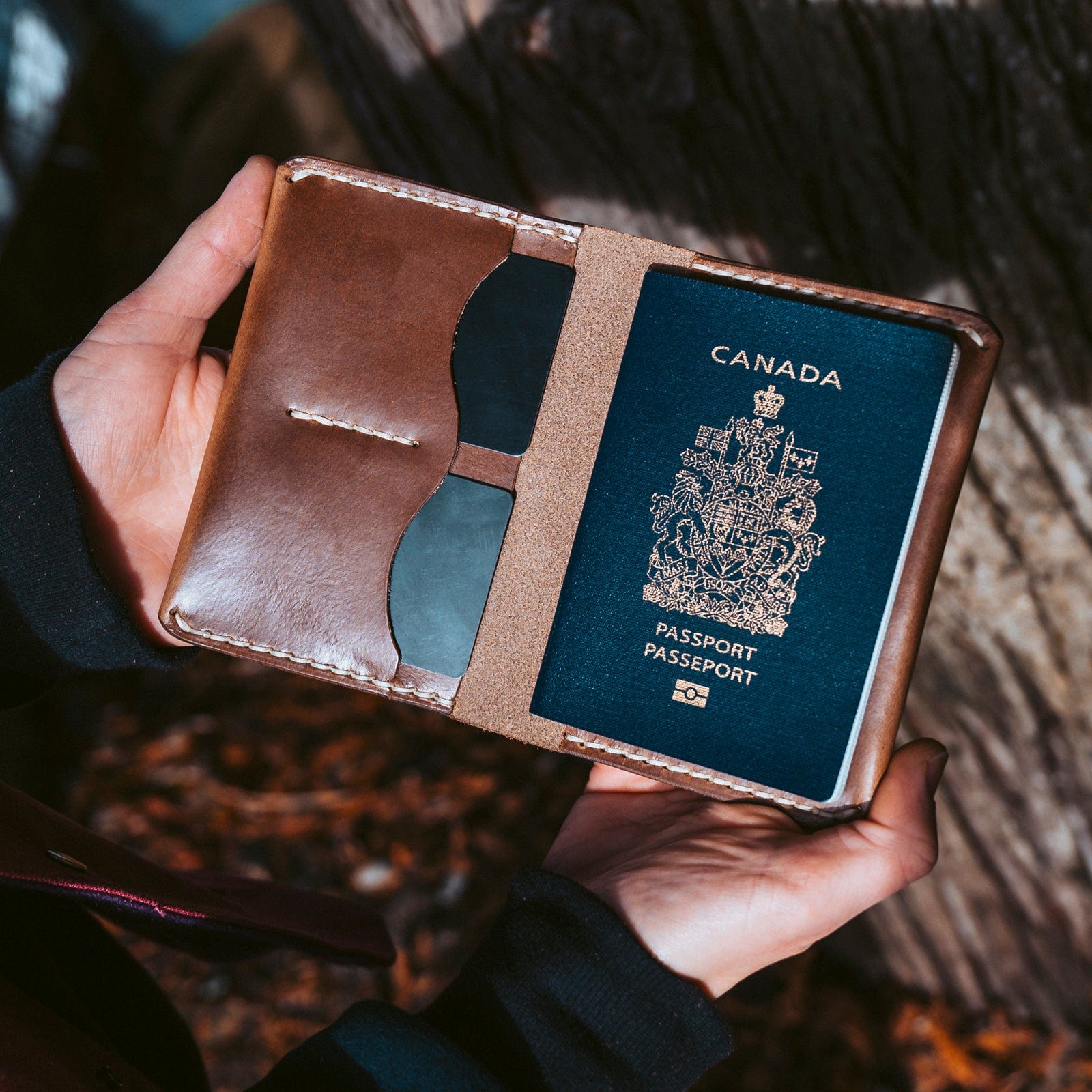
It also works for cards you do not keep in a wallet at all. Building access fobs, transit cards, and a passport card can sit against the Gauntlet in a jacket pocket or a travel pouch. If you are searching for an RFID protector for a wallet you already own and love, this is the shortest path there.
- Type: credit card sized RFID blocking insert
- Fits: any standard card slot
- Use with: any leather wallet, ours or otherwise
- Made in: Nelson, British Columbia
- Best for: adding RFID protection without changing your carry
2. Leather Front Pocket Wallet

If you want the smallest sensible everyday carry, this is where I would start. It holds the cards you actually use and folded bills, and it rides flat in a front pocket where a wallet is harder to reach and harder to scan from a distance in the first place. Pair it with the Gauntlet and you have a slim leather wallet with RFID protection that still disappears in your jeans.
It is cut from thick full-grain leather and saddle-stitched by hand with Tiger thread from Julius Koch. Hand saddle-stitching uses two needles passing through the same hole from opposite sides, so a single cut stitch cannot unzip the seam the way a machine lockstitch can. That matters most on a wallet, which gets flexed and stuffed and sat on thousands of times a year.
- Style: slim front pocket carry
- Leather: full-grain, combination tanned
- Construction: hand saddle-stitched, Tiger thread
- Guarantee: lifetime
- Best for: minimalists who want RFID protection without bulk
3. Leather Trifold Wallet

The trifold is the one I recommend to people who carry a lot: work cards, a couple of bank cards, a membership card, an ID, and cash. It gives you the most organized storage of anything we make in the wallet line, with a flip-out ID window so you are not digging at the counter.
Because a trifold has more card slots than most, it is also the wallet where an RFID blocker earns its keep. Slide the Gauntlet in behind the stack and the contactless cards sitting against it are shielded. This is a good pick as a leather wallet for him or for her, since the layout is the same regardless of who is carrying it, and it is one of the few designs that handles a fat card stack without looking overstuffed.
- Style: trifold with flip-out ID window
- Leather: full-grain, combination tanned
- Construction: hand saddle-stitched, Tiger thread
- Guarantee: lifetime
- Best for: bigger card counts and daily organization
4. Leather Money Clip Wallet

Some people want cards on one side and cash held firmly on the other, without the folded-bill lump a bifold creates. That is this wallet. The clip keeps bills flat and accessible, the card slots keep the profile tight, and the whole thing stays thin even when it is full.
For RFID purposes, the money clip is a good candidate for a blocking card because the card side is compact. Fewer slots means the Gauntlet sits closer to everything it needs to protect. If you travel with a small stack and want a leather wallet that looks sharp out of a jacket pocket, this is the one I reach for.
- Style: card slots plus integrated money clip
- Leather: full-grain, combination tanned
- Construction: hand saddle-stitched, Tiger thread
- Guarantee: lifetime
- Best for: cash carriers who still want a slim profile
5. Saddleback Leather Men's Wallets
Worth knowing about if you are comparing makers. Saddleback Leather's men's wallet range comes from a shop that built its reputation on heavy full-grain leather and deliberately overbuilt construction. Their pieces run thicker and heavier than most, which some people love and some people find is more wallet than a back pocket wants.
I mention them because they are honest about what they make and they stand behind it, which is rare enough to respect. If you want a leather wallet that reads as substantial the moment you pick it up, they are worth a look. Just check the specifics of RFID on any individual model before you buy, since heavy leather by itself does not shield contactless cards any more than thin leather does.
Quick Comparison
| Product | Type | Leather | Construction | Guarantee | Best For |
|---|---|---|---|---|---|
| Wallet Gauntlet | RFID blocking card | n/a | Card-sized insert | Lifetime | Adding RFID protection to any wallet |
| Leather Front Pocket Wallet | Slim wallet | Full-grain, combination tanned | Hand saddle-stitched | Lifetime | Minimal everyday carry |
| Leather Trifold Wallet | Trifold | Full-grain, combination tanned | Hand saddle-stitched | Lifetime | Larger card counts, ID window |
| Leather Money Clip Wallet | Money clip wallet | Full-grain, combination tanned | Hand saddle-stitched | Lifetime | Cash plus a small card stack |
| Saddleback Men's Wallets | Bifold and card styles | Full-grain, per the maker | Stitched, per the maker | See maker's terms | Heavier, overbuilt carry |
How Does RFID Blocking Actually Work?
A contactless bank card, a hotel key, or a transit pass has a small antenna and a chip inside it. It has no battery. When a reader is close enough, the reader's field powers the chip up and the two talk to each other. That is why tapping works at all, and it is why the range is short: the card needs to sit in the reader's field to wake up.
An RFID blocker interferes with that handshake. A thin conductive layer between the reader and your card absorbs and scatters the field, so the chip never gets enough energy to answer. That is all a wallet RFID protector is doing. It is not encryption or software, it is physics, and it is the same principle whether the shielding is sewn into a wallet lining or carried as a separate card.
Two things worth being clear about. First, magnetic stripe cards and chip-and-PIN cards that need physical contact are not readable this way at all, so blocking does nothing for them either way. Second, a blocking card protects what is close to it. Cards on the far side of a thick, stuffed wallet are less well covered than the ones sitting right against it, which is one more reason a slim wallet is a friend to RFID protection.
Why a Handmade Leather Wallet Matters
Full-grain leather is the outermost layer of the hide with the grain left intact. Nothing has been sanded off to hide blemishes, which is what separates it from top-grain, and it is not ground-up scrap glued back together, which is what bonded leather is. Full-grain is the strongest part of the hide and it is the only kind that develops the patina people are after, darkening and softening in the spots your hands touch most.
Our leather is combination tanned at the Seidel tannery, which gives us a hide with the body and structure to hold an edge and a fold, plus the water resistance and colour depth that a wallet needs when it lives in a pocket every day. Then every wallet is cut, punched, and saddle-stitched by hand here in Nelson, British Columbia, with waxed Tiger thread from Julius Koch. It is slower than running a seam through a machine. It is also why we can back every wallet with a lifetime guarantee without flinching.
"A wallet fails at the stitching long before the leather gives out. That is why we still saddle-stitch every one by hand. Two needles, one hole, thread locked from both directions. If a stitch gets cut, the seam holds. Everything else we do, the leather we buy, the edges we finish, only matters if that seam is going to last twenty years."
Ryan Popoff, founder, Popov Leather
How to Choose Your Wallet and Blocker
Start with your card count. Count what you carry today, not what you wish you carried. Four or five cards points to a Leather 5 Card Wallet or the front pocket style. Eight or more points to the trifold or a Traditional Bifold Leather Wallet.
Decide about cash. If you still carry bills, a bifold or trifold holds them flat and out of sight. If you carry a few notes and hate the bulk, the money clip design is the cleaner answer.
Pick the pocket. Front pocket carry is easier on your back and, incidentally, harder to reach from behind you in a crowd. Back pocket carry favours a bifold or trifold that sits flat.
Add the blocker deliberately. One Gauntlet, positioned behind the contactless cards you care about, covers the practical case. If you split cards between a wallet and a travel pouch, consider one for each.
Think in cost per year, not cost per wallet. A cheap wallet replaced every eighteen months costs more over a decade than one full-grain wallet that gets better looking the whole time. The lifetime guarantee is the part that makes that math real rather than a slogan.


You can see the full lineup in our leather wallets collection if you want to compare layouts side by side.
Caring for the Wallet You Just Bought

Full-grain leather does not need much, but it does need something. A wallet lives against your body, absorbs oils, then dries out again. Once or twice a year, wipe it down and work a small amount of Popov Leather Care in with a cloth. Thin coats, not thick. Let it sit, then buff.
Keep it out of the washing machine, keep it out of direct heat if it gets soaked, and let it dry at room temperature. An RFID blocking card needs no maintenance at all beyond staying in the wallet, and it will not interfere with conditioning the leather around it.
Frequently Asked Questions
Do leather wallets block RFID on their own?
What is the best RFID blocker for a wallet?
Does an RFID blocking card protect every card in my wallet?
Will an RFID blocking card stop my cards from working?
Can I add RFID protection to a wallet I already own?
Are RFID blocking wallets worth it?
Which Popov wallet works best with an RFID blocking card?
How do I care for a full-grain leather wallet?
The Verdict
For 2026, my pick is the combination rather than a single product: the Wallet Gauntlet RFID Blocking Card in whichever of our wallets suits your carry. If you want one wallet to start with, make it the Leather Front Pocket Wallet for slim everyday use, or the Leather Trifold Wallet if you carry more than a handful of cards. Full-grain leather, hand saddle-stitched in Nelson, British Columbia, backed for life, and shielded where it counts. That is the whole answer, without the marketing.